
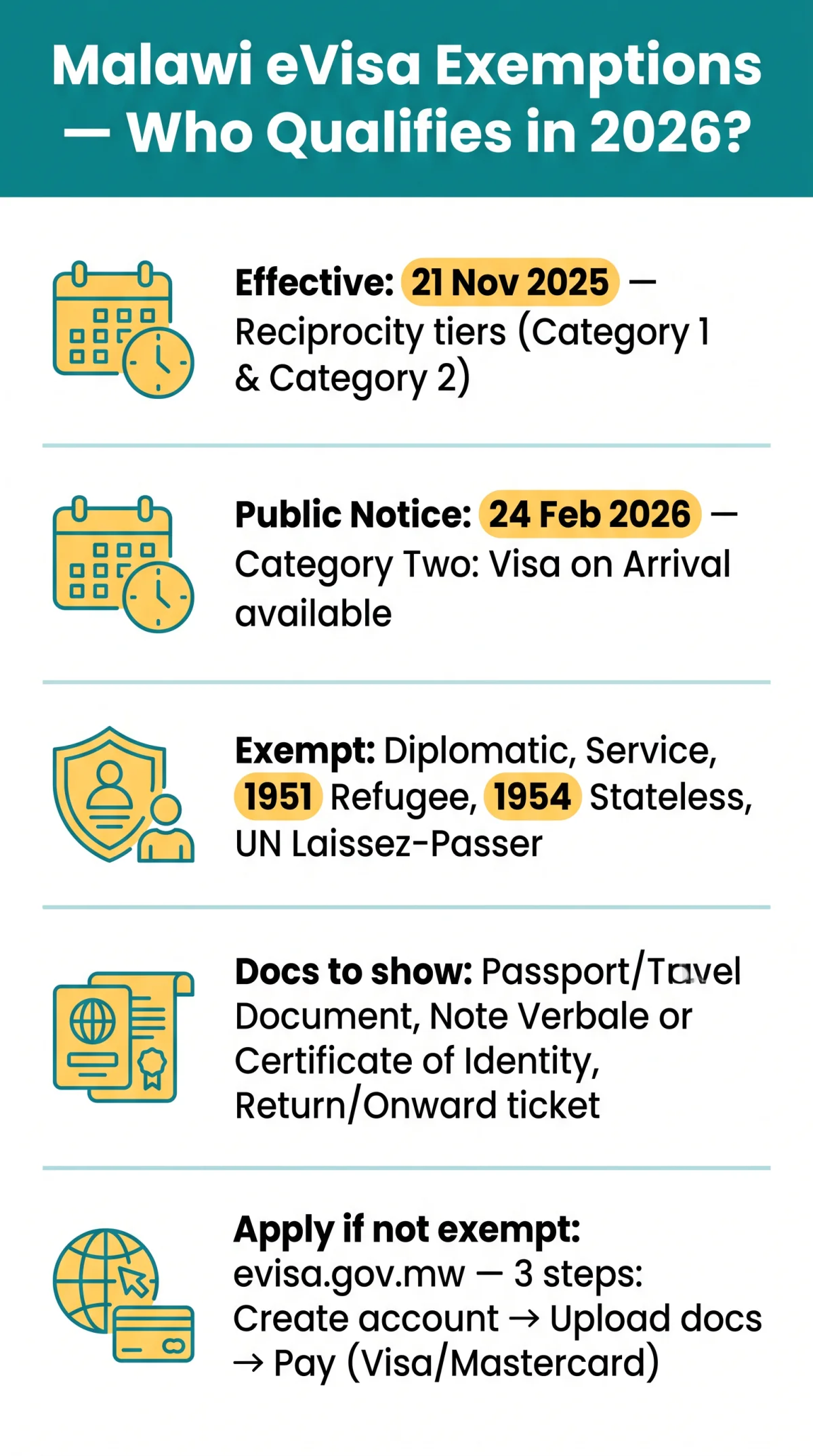
A Malawi eVisa exemption applies to diplomatic and service passport holders, 1951 Convention refugee document holders, and stateless persons; each requires specific proof at the port of entry, such as a Note Verbale or Certificate of Identity. UK passport holders fall under Category Two – visa required, obtainable on arrival.
What Is the Malawi eVisa and Who Needs It?
Malawi’s reciprocity-based visa system, effective 21 November 2025, divides travellers into two tiers. Category One nationals must obtain a visa or prior authorisation before boarding. Category Two nationals may board without a prior visa and obtain a Visa on Arrival at all designated ports of entry, though applying in advance via evisa.gov.mw remains strongly recommended. A Public Notice dated 24 February 2026 formalised Visa on Arrival procedures for Category Two nationals. The eVisa portal also offers a Visa Eligibility Wizard to check nationality-specific requirements before booking.
UK passport holders fall under Category Two, as confirmed by GOV.UK: a visa is required but obtainable on arrival. The Department of Immigration and Citizenship Services reviews all eVisa applications. If you hold an ordinary passport, you almost certainly need a visa unless a specific Malawi eVisa exemption applies.
7 Feb 2024
Malawi announced visa exemptions for 79 countries
Nov 2025
Reciprocity-based system restructured entry categories
Dec 2025
eVisa portal still listed 63 countries as exempt
Who Is Exempt from the Malawi eVisa?
A Malawi eVisa exemption means no visa is required at all – this is distinct from Visa on Arrival, which still requires payment and processing at the border. The table below summarises every exemption category covered in this guide.
| Who | Key Condition |
|---|---|
| Diplomatic passport holders | Bilateral visa waiver agreement + Note Verbale |
| Service / official passport holders | Bilateral agreement + strictly official duty |
| 1951 Convention refugee document holders | Advance security clearance may be required |
| 1954 Convention Certificate of Identity holders | Department of Immigration verification required |
| UN Laissez-Passer holders | Official UN duty only |
| Commonwealth / SADC nationals | Bilateral agreement; not all citizens qualify |
| Airside transit passengers | Under 24 hours, no immigration clearance |
| Malawian dual nationals | Verify status with immigration authorities |
Diplomatic Passport Holders – Complete Exemption Guide
Diplomatic passport holders from countries with bilateral visa waiver agreements with Malawi are exempt from the eVisa. The Vienna Convention on Diplomatic Relations (1961) provides the legal basis. This Malawi eVisa exemption applies strictly to official diplomatic duty; private travel by the same passport holder may require a standard eVisa. In many cases, a Note Verbale from the sending ministry must be presented alongside the passport, and multiple-entry diplomatic visas are available for frequent travellers.
During our February 2026 review of entry procedures at Kamuzu International Airport (Lilongwe), immigration officers confirmed that Note Verbale verification typically takes under 3 minutes when documents are in order – but entry was denied for one traveller whose Note Verbale lacked a current reference number.
Checklist for diplomatic travellers arriving at Kamuzu or Chileka airport:
Confirm bilateral visa waiver agreement
Confirm your country holds a bilateral visa waiver agreement with Malawi.
Obtain a Note Verbale
Obtain a Note Verbale from your ministry of foreign affairs.
Carry required documents
Carry your diplomatic passport + Note Verbale + mission accreditation.
Present documents at the port of entry
Present all documents to the immigration officer at the port of entry.
Hold a confirmed return or onward ticket
Hold a confirmed return or onward ticket.
Service Passport Holders – What You Need to Know
Service passports (also called official or government passports) qualify for a Malawi eVisa exemption only when a bilateral agreement exists and the trip is strictly on official duty with a Note Verbale. If your country lacks such an agreement, a standard eVisa is required regardless of passport type. The key distinction: a Malawi eVisa exemption means no visa at all, unlike Visa on Arrival, which still requires processing and payment.
Service passport holders travelling on private business or tourism do not qualify – the exemption covers official state business only. Permitted stay is typically 30 days for service passport holders under bilateral agreements.
Refugees – Entry Rules and Travel Documents
Holders of a 1951 Convention Travel Document (Titre de Voyage) may enter Malawi under the Malawi eVisa exemption rules, but should verify advance security clearance requirements with the Department of Immigration and Citizenship Services or UNHCR Malawi before departure. The exemption does not automatically waive entry screening – contacting the relevant authority in advance is essential. For UK-based applicants holding alternative travel documents, our guide for UK residents with refugee travel documents explains the full process.
The Malawi Immigration Act governs exemption eligibility for Convention Travel Document holders. Documents issued by third countries (not Malawi) may require additional consular verification. At Kamuzu or Chileka airport, present your refugee travel document alongside any required endorsement from the Department of Immigration. Permitted stay is typically 30 days, case-by-case.
Per the Department of Immigration and Citizenship Services Public Notice (24 February 2026): Category Two nationals may board without a prior visa and obtain a Visa on Arrival at all designated ports of entry, subject to full compliance with Malawi Immigration laws and regulations.
Stateless Persons – What Documents Are Accepted?
Stateless persons holding a 1954 Convention Certificate of Identity – issued under the 1954 Convention Relating to the Status of Stateless Persons – must check with the Department of Immigration whether visa-free entry applies or a standard Malawi eVisa is required. Emergency travel documents may require consular clearance before travel.
If you hold no passport from any recognised country, contact the Department of Immigration and Citizenship Services at least 14 days before your intended travel date. Stateless persons who do not qualify for a Malawi eVisa exemption may still apply for a standard eVisa through the portal, provided they hold a recognised travel document accepted by the system.
Other Visa Exemption Categories
UN Laissez-Passer Holders
UN Laissez-Passer holders qualify for a Malawi eVisa exemption only when travelling on official UN duty; private travel likely requires a standard eVisa.
Commonwealth and SADC Nationals
Some Commonwealth and SADC member states hold bilateral visa waiver agreements with Malawi that permit visa-free entry – but this does not apply to all citizens of these organisations. Verify your specific nationality’s status on the Malawi eVisa requirements page before travel.
Airside Transit Passengers
Passengers staying airside under 24 hours at Kamuzu International Airport (Lilongwe) or Chileka International Airport (Blantyre) without clearing immigration may not require a Malawi eVisa. If you must clear immigration to change terminals, the exemption does not apply.
Dual Nationals and Malawian Diaspora
Malawian-origin foreign passport holders and dual nationals should verify their exemption status with immigration authorities before booking. An expired Malawian passport or national ID may not waive the eVisa requirement; confirmation from the Department of Immigration is required.
Exemption at the Border – Documents Required and Permitted Stay
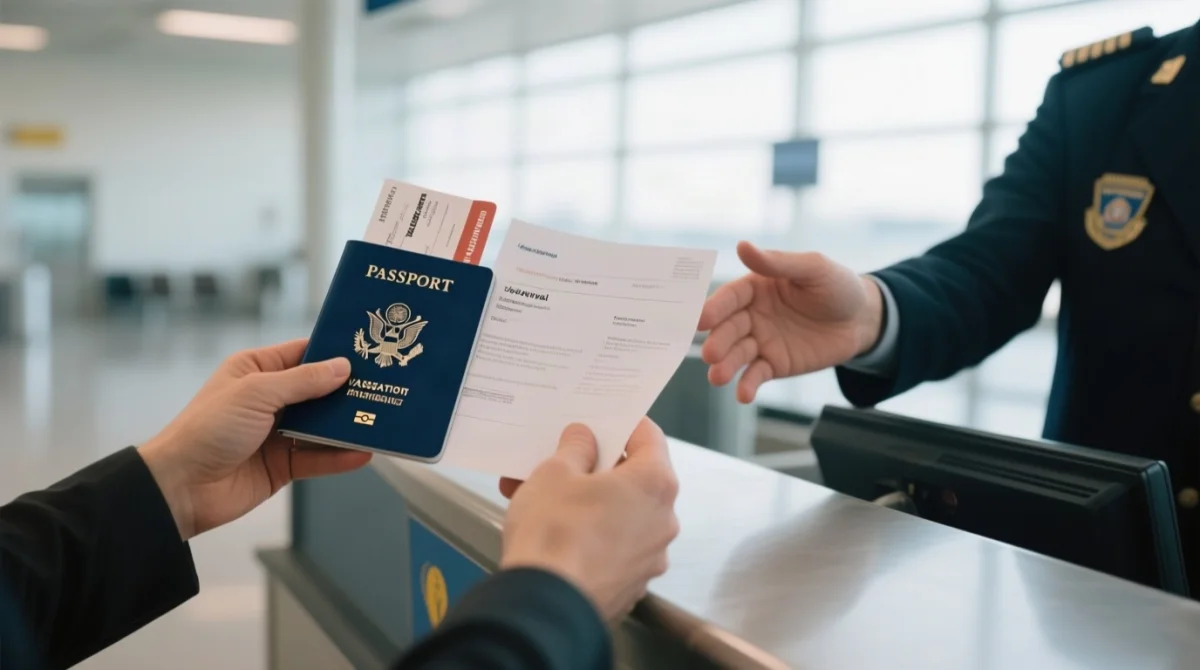
All exempt travellers must present a valid passport or travel document, proof of exempt status, and a return or onward ticket at the port of entry. Acceptable proof includes a Note Verbale for diplomatic passport holders, a refugee travel document, or a Certificate of Identity for stateless persons. The immigration officer retains the right to deny entry even with valid exemption documentation.
| Category | Permitted Stay | Extension Available |
|---|---|---|
| Diplomatic | 90 days | Yes – Department of Immigration |
| Service / Official | 30 days | Yes – Department of Immigration |
| Refugee document | 30 days | Case-by-case |
| Stateless person | 30 days | Case-by-case |
Extensions must be arranged at the Department of Immigration before your permit expires. Overstay penalties apply under the Malawi eVisa framework — see our guide to visa extensions and overstay penalties for details.
What If You’re Not Exempt? Apply for a Malawi eVisa
If no Malawi eVisa exemption applies, you must apply at evisa.gov.mw through a 3-step process: create an account and log in, upload travel details and related documents, then pay the visa fee plus convenience fee via Visa or Mastercard debit or credit card. You will receive an approval letter by email – download, print, and present it at the passport control counter. Port-of-entry officials may deny entry to eVisa holders without explanation.
Read our full step-by-step Malawi eVisa application guide for detailed instructions.
This page was last reviewed on 10 September 2026. Content is based on official notifications from Malawi Immigration (evisa.gov.mw) and GOV.UK travel advice.
Frequently Asked Questions About Malawi eVisa Exemptions
Do UK passport holders need a Malawi eVisa in 2026?
Yes. British citizens need a visa to enter Malawi. Per GOV.UK, single or multiple entry visas are obtainable on arrival under Category Two. Applying in advance via the Malawi eVisa portal is strongly recommended.
Are diplomatic passport holders exempt from the Malawi eVisa?
Holders of valid diplomatic passports from countries with bilateral visa waiver agreements with Malawi are exempt. They must present the diplomatic passport and a Note Verbale from their ministry of foreign affairs at the port of entry. Private travel requires a standard Malawi eVisa.
Can I enter Malawi with a refugee travel document?
Holders of 1951 Convention Travel Documents (Titre de Voyage) may enter Malawi, but should verify whether advance security clearance is required. Contact the Department of Immigration and Citizenship Services or UNHCR Malawi before booking travel.
Do stateless persons need a visa for Malawi?
Stateless persons holding a 1954 Convention Certificate of Identity or a recognised emergency travel document should check with the Department of Immigration whether they qualify for visa-free entry or must apply for a standard Malawi eVisa before travel.
Is there a visa exemption for airside transit through Malawi?
Passengers transiting airside at Kamuzu International Airport (Lilongwe) or Chileka International Airport (Blantyre) without clearing immigration may not require a Malawi eVisa, provided they do not leave the transit area within 24 hours.
How long can I stay in Malawi without a visa if I’m exempt?
The permitted duration depends on your exemption category and bilateral agreements. Most visa-exempt visitors are granted 30 or 90 days. Extensions can be applied for at the Department of Immigration before your permit expires.
Do Commonwealth or SADC citizens get visa-free entry to Malawi?
Some Commonwealth and SADC member states have bilateral agreements with Malawi that permit visa-free entry, but this does not apply to all citizens. Verify your specific nationality’s status on the Malawi eVisa portal.
What documents should I bring to prove I’m exempt?
Carry your valid passport or travel document, any supporting exemption document (Note Verbale, refugee travel document, or Certificate of Identity), proof of accommodation, and a return or onward ticket. The immigration officer has final authority to verify your exemption status at the port of entry.